
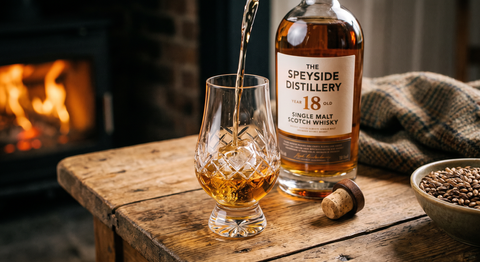
You're buying a whisky for someone who knows whisky. Two bottles sit side by side on your screen. One says single malt and costs sixty dollars more. The other says blended malt, which sounds like the budget version of the same thing.
You pick the single malt, because single sounds special. One barrel, one batch, hand chosen. That's what you're paying for, surely.
Not quite. The word everyone gets wrong is single.
The short answer
Single malt means one distillery, not one barrel. It's whisky made only from malted barley, at a single distillery, and it's almost always a mix of many casks, often of different ages, married together before bottling.
It's one of the questions we get asked most around gifting season, usually by someone about to spend real money and quietly worried they're about to get it wrong.
What single malt actually is
For Scotch, this isn't a matter of opinion. It's law. Under the UK's Scotch Whisky Regulations 2009, a Single Malt Scotch Whisky has to tick three boxes: distilled at a single distillery, made from water and malted barley with no other cereals, and distilled in pot stills. Like all Scotch, it then has to mature in Scotland for at least three years in oak casks of no more than 700 litres, and be bottled at 40% ABV or higher.
Read those boxes again and notice what isn't there. Nothing says one cask. A distillery can pull whisky from hundreds of barrels, from different years, and blend them in a vat to hit its house style. As long as every drop came from that one distillery, it's single malt.
Think of it like a bakery. A single malt is every loaf coming out of one bakery's ovens. It isn't one loaf.
The five kinds of Scotch, side by side
Here's the trap sitting in the middle of that table. Blended malt is not a cheaper single malt with filler. It's 100% malt whisky, made exactly the same way, just from more than one distillery. No grain whisky allowed. Some of the most interesting bottles in whisky sit in that row, because a blender with several distilleries to draw from has more colours to paint with.
Which one should you actually buy?
- A gift for someone who already drinks whisky: a single malt from a distillery with a clear personality. Smoky Islay, sherried Speyside, coastal Highland. The point is a sense of place.
- Your first proper bottle: a blended malt. All malt, easy to like, and usually kinder on the wallet than a single malt of similar quality.
- Highballs, mixing, or a crowd with mixed tastes: a blended Scotch. Blends are built for smoothness and consistency, which is exactly what a long glass needs.
- Someone curious about what whisky can do: two single malts from opposite ends of Scotland. Same rules, completely different drinks.
- The collector in your life: look for "single cask" on the label. That's the one-barrel bottle people think single malt already is.
What does the age on the label mean?
The number is the age of the youngest whisky in the bottle, not the average. A 12 year old single malt may well contain whisky that's 15 or 18 years old, but nothing younger than 12.
Whisky only ages while it's in the cask. Once it's bottled, the clock stops. A 12 year old bought today and opened in a decade is still a 12 year old.
Plenty of good single malts carry no age statement at all. That's not a red flag. It usually means the distillery wants the freedom to use younger casks alongside older ones to get the flavour it's after.
Is single malt better than a blend?
No, and this is worth saying plainly. Single malt tells you about origin, not quality. A great blend is a feat of skill, and a dull single malt is still dull.
Single malts tend to show more individual character because they come from one place with one set of stills. Blends are about balance. Which one you prefer depends on whether you want a whisky that makes a statement, or one that gets out of the way. Both are tools for different nights.
Does single malt only come from Scotland?
No. Distilleries in Japan, Ireland, Taiwan and Australia all make single malts, and some of the most talked about bottles in the world now come from outside Scotland.
The rules just aren't the same everywhere. In Australia, whisky has to spend at least two years in wood, but there's no formal legal definition of single malt. Most Australian producers follow the Scottish model voluntarily: malted barley, one distillery, pot stills. It's worth knowing that what the term guarantees depends on where the bottle comes from.
The plot twist: nobody was selling it
For most of whisky history, single malt wasn't something you bought. It was an ingredient.
Distilleries sold their malt whisky to blenders, who mixed it with grain whisky and sold the result under their own names. Outside Scotland, Scotch basically meant blended Scotch, and blends still make up the large majority of Scotch sold today.
That changed in 1963, when Glenfiddich, a family owned Speyside distillery, decided to market its own malt as a product in its own right, outside Scotland. It's widely credited as the first to do it seriously. The label didn't even say single malt, because the category didn't have a settled name yet. It was reportedly sold as "Straight Malt", then "Pure Malt", before "single malt" stuck. By some accounts, the rest of the industry thought it was a foolish idea.
So when a friend insists single malt is the original, purer form of Scotch, you can mention that, as something you could actually buy off a shelf, it's roughly the same age as the Beatles' first album.
The bottom line
Single malt is a promise about where a whisky was made and what it was made from. It isn't a promise of one barrel, a higher age or a better drink. Read the label as a map, not a ranking, and you'll buy better bottles for less guesswork.
The quickest way to really get it: open a blended malt and a single malt the same night. Try something like Monkey Shoulder next to a Speyside single malt such as Mortlach's 12 year old. Both all malt, same country, one distillery against several. Pour them side by side and you'll taste exactly what that one word on the label is worth to you.
Browse our Scotch whisky range, with fast delivery Australia wide and free shipping across NSW on orders over $150. Buying for someone and not sure where to start? Email us at order@whiskywinesake.com.au and tell us what they usually drink. We'll point you to the right bottle.
FAQs
What does single malt mean?
Whisky made only from malted barley at a single distillery. For Scotch, it must also be distilled in pot stills, under the Scotch Whisky Regulations 2009.
Is single malt whisky from one barrel?
No. Most single malts are a mix of many casks from the same distillery. A whisky from one barrel is labelled single cask.
What's the difference between single malt and blended malt?
Single malt comes from one distillery. Blended malt combines single malts from two or more distilleries. Both are made only from malted barley.
Is single malt better than blended Scotch?
Not automatically. Single malt describes how and where a whisky was made, not its quality. Blends prize balance, single malts show a distillery's character.
What does the age statement on a single malt mean?
It's the age of the youngest whisky in the bottle. Older whisky can be in there too, but nothing younger.
Can single malt be made outside Scotland?
Yes. Japan, Ireland, Taiwan and Australia all produce single malts, though the legal definition varies by country. Australia has no formal legal definition of the term.
Comments (0)
There are no comments for this article. Be the first one to leave a message!